
A Kingdom Not of This World
Naming Christian nationalism honestly, from both directions
Ask ten Christians what “Christian nationalism” means and you’ll get ten different answers — and at least three different tones of voice. For some, it’s a slur used to delegitimize ordinary patriotism and public faith. For others, it’s a precise and urgent warning about a real theological drift happening inside American churches. Both instincts are picking up on something true. Neither one, alone, tells you what you actually need to know.
What’s Going On Right Now
The term has moved from academic journals into everyday conversation faster than almost any other phrase in American religious life. A Pew Research Center study found that 59 percent of U.S. adults now say they’ve heard at least a little about Christian nationalism, up from 45 percent just two years earlier. That’s not a fringe conversation anymore. It’s dinner-table material.
Part of what’s driving the awareness is action, not just argument. The current administration established a Religious Liberty Commission in 2025 aimed at shaping domestic policy, and one of its board members has publicly dismissed the idea of church-state separation as one of the biggest lies in the nation’s history. Meanwhile a separate 2026 Pew survey found that 79 percent of Americans still say churches shouldn’t endorse candidates, and two-thirds want houses of worship to stay out of day-to-day political fights — a reminder that most people, including most churchgoers, are uneasy with fusion even as some of their leaders move toward it.
The data on where this actually lives is worth sitting with. A PRRI survey based on more than 22,000 interviews found that roughly 11 percent of Americans qualify as Christian nationalism “adherents” and another 21 percent as “sympathizers,” while nearly two-thirds are skeptics or outright rejecters. But among Republicans specifically, that number climbs to 56 percent who are adherents or sympathizers, compared to a quarter of independents and 17 percent of Democrats — which means for a lot of conservative congregations, this isn’t a hypothetical debate about people far away. It’s a live current running through the pews.
That matters most if you consider yourself a conservative Christian. This isn’t written to score points against people who love their country. It’s written because the sharpest form of this drift tends to show up closest to home, not far away.
The Tension Worth Sitting With
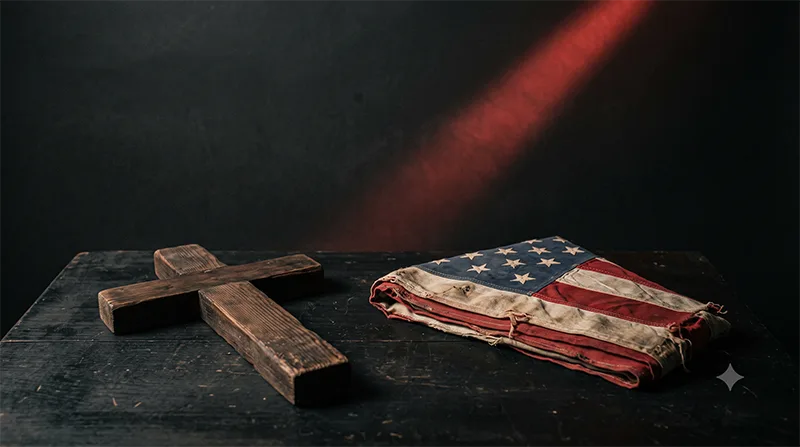
Here’s what needs to be said plainly, and held in both hands at once: a legitimate love of country and gratitude for its freedoms is not the problem. Scripture never condemns patriotism. What it does warn against, repeatedly and without ambiguity, is the moment a nation’s story starts functioning as the same story as the gospel — when the flag and the cross start meaning the same thing to the same heart.
That’s the actual danger. Not love of country. Fusion of country with the kingdom.
What Scripture Says
John 18:36 — Standing before Pilate, with His life on the line, Jesus doesn’t defend an earthly claim to power. My kingdom is not of this world, He says — if it were, His followers would be fighting for it. His kingdom runs on an entirely different logic than the kingdoms Pilate understood.
Philippians 3:20 — Paul writes to believers living under an actual empire, one with real coercive power over their lives, and tells them plainly: our citizenship is in heaven. Not as an escape hatch from present responsibility, but as their primary identity — the thing that orders everything else.
1 Peter 2:9, 11 — Peter calls the church a chosen people, a royal priesthood, and in the next breath urges believers to live as sojourners and exiles. The church’s core self-understanding in Rome was resident alien, not conquering majority. That’s not a posture of defeat. It’s a description of where ultimate belonging actually sits.
Daniel 3:17–18 — Facing execution for refusing to bow, three men tell the king: our God is able to deliver us… but even if He does not, we will not bow. Their loyalty to God explicitly outranks their loyalty to the empire that had fed, educated, and promoted them. That’s the whole tension, held in one sentence.
Where This Leaves Us
When a flag and a cross start functioning as the same symbol, it is almost always the gospel that quietly loses — not the flag. A shrunken gospel that fits neatly inside one nation’s borders is a gospel that has already stopped being good news for the rest of the world, and eventually stops being good news at all.
The corrective isn’t political silence, and the corrective to apathy isn’t fusion. It’s the sojourner posture Daniel modeled: serving the empire with real excellence, real competence, real civic investment — while reserving ultimate allegiance for God alone, even when that allegiance costs something.
This also means resisting the urge to let the term itself do all the thinking. Some researchers who’ve surveyed politically engaged conservative Christians have found that what looks like Christian nationalism from the outside is, for many people, closer to a general conservative identity politics — a defensive posture shaped more by feeling culturally besieged than by an explicit theological claim that America is a Christian nation. That distinction matters pastorally. A congregant who feels dismissed and mocked by the wider culture needs a different conversation than a congregant who genuinely believes the government should enforce Christian law. Lumping them together with the same accusation will only entrench both.
At the same time, the drift is real enough that it can’t be waved away as a media invention. The same PRRI research found that Christian nationalism adherents were three times more likely than rejecters to agree that “true American patriots” may eventually need to resort to violence to save the country. That’s not a rhetorical flourish. That’s a warning sign worth taking seriously inside our own tribe, not just pointing at someone else’s.
Three Ways Forward
1. Define the term honestly. Don’t let either side’s caricature do the thinking for you. Before a congregation can evaluate Christian nationalism, they need to know what’s actually being claimed — is it “Christians should have equal cultural voice,” or “the government should enforce Christian law”? Those are very different claims wearing the same label.
2. Locate the actual danger. It isn’t patriotism, gratitude, or civic participation. It’s the specific moment when national identity and gospel identity start to feel like the same thing — when questioning the nation starts to feel like questioning the faith.
3. Recover the sojourner identity. Daniel didn’t disengage from Babylon, and he didn’t fuse himself to it either. He served with excellence and refused with his life when those two paths diverged. That’s the model — not withdrawal, not fusion, but allegiance held in the right order.
Where this book fits
This is the exact tension Whose Kingdom? is written to untangle — not as a culture-war referee, but as a pastoral case for what it actually means to belong to Christ’s kingdom first, in a nation you’re still called to love, serve, and pray for. If this piece raised more questions than it answered, that’s the point of the book.
Daniel served Babylon with excellence and refused it with his life. That’s the whole tension in one man.