
When Your Faith Starts Coming Apart
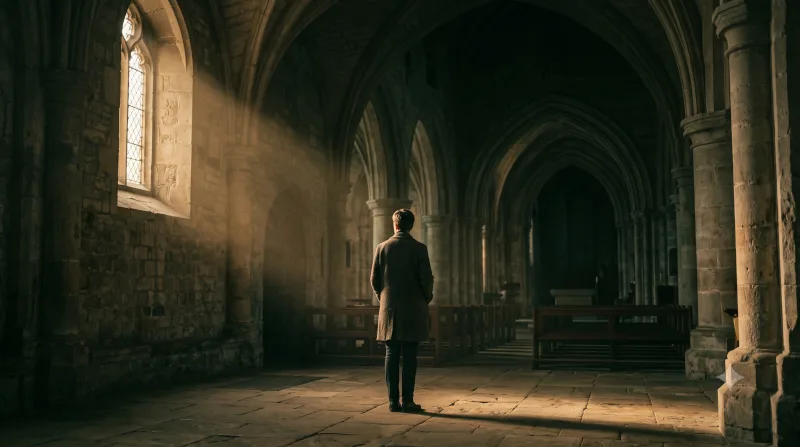
Doubt is not the opposite of faith. Handled with care, it’s often the road faith takes home.
It usually starts quietly.
A question you were always told not to ask stops going away. A verse you’d read a hundred times suddenly reads differently, and you can’t un-see it. Something a leader did, or something the church said, or something that happened to you, opens a hairline crack — and through it, for the first time, the whole structure looks less solid than you’d assumed. And underneath the question is a deeper, more frightening one: If I pull on this thread, does the whole thing come apart? And if it does, am I already gone?
If that’s where you are, I want to say something plainly before anything else. You are not the first person to stand here. You are not faithless for standing here. And you are not nearly as alone as the silence around you makes it feel.
Here’s something worth knowing about how this tends to work: most people don’t decide to start deconstructing. It isn’t usually a rebellion you choose one morning. More often it’s triggered — by pain, by a wound the church gave you, by a doubt you suppressed for years until it finally surfaced. As the authors of a recent book on the subject put it, deconstruction is typically not something people choose; it’s something that happens to them. Which means if you’re here, you probably didn’t go looking for this. It came looking for you. That matters, because it means the first thing you need isn’t a verdict on whether you’re a good Christian. It’s someone to sit with you in the crack while you look.
Let me try to be that someone for a few minutes.
A conversation louder than it is large
You should know what world you’ve wandered into, because it will shape how alone you feel.
“Deconstruction” is now a whole online ecosystem — its own hashtags, its own influencers, its own conferences, even its own coaches who will walk you toward the exit for a fee. Scroll long enough and you’ll find charismatic people who left the faith entirely and now make their living narrating why, often to applause. It can feel, from inside the feed, like everyone is leaving, like the honest and the intelligent have all quietly filed out and you’re just the last one to notice.
But the feed is lying to you about the size of the room.
When sociologists actually count, a more interesting picture emerges. For two decades, the share of Americans claiming no religion climbed steadily — but the best recent data suggests that climb has stalled. Pew now finds the religiously unaffiliated holding roughly steady, near three in ten, essentially flat since 2019. Researchers at Lifeway went so far as to say the long rise of the “nones” has, for now, ended. And the loudest voices in the deconstruction conversation — the ones who left it all behind — turn out to be, in the words of one sociologist who studies this closely, a distinct but incredibly vocal minority, driven overwhelmingly by the young and the very online.
I don’t tell you this to shame anyone or to wave away real reasons people leave. I tell you because the algorithm has convinced a lot of honest doubters that they face a binary — snap back to unquestioning certainty, or join the exodus — when in fact the vast, quiet middle is exactly where you are: people taking their faith apart carefully, in the hope of putting something truer back together. That middle doesn’t trend. It doesn’t make content. But it’s where most of the real work of God happens.
What the church too often does with a question
I have to be honest about my own house now, because we’ve earned the criticism.
Here is what too often happens when someone brings a genuine question to church. The question gets treated as a threat. A doubt gets handled like a fire to stamp out, a symptom of rebellion, a sign that this person has been reading the wrong things or keeping the wrong company. The subtext the questioner receives, loud and clear, is: your doubt is not welcome here — and so, at some level, neither are you.
And then we act surprised that the people most willing to think are so often the first to leave.
We have it exactly backwards. When someone you love is coming apart, the goal is not to win the argument. Winning the argument has probably never once kept a deconstructing person in the faith — it just teaches them to stop telling you the truth about where they are. The pastor’s first job, the parent’s first job, the friend’s first job, is far simpler and far harder: stay in the room. Fear empties rooms. And a church that responds to honest questions with fear will, over time, be left with only the people who never ask any — which is not the same thing as a church full of strong faith. It’s often just a church full of people who’ve learned to hide the crack.
Not all deconstruction is the same
Now let me turn back to you, and be as honest with you as I’ve just been with the church.
Not everything that goes by the name “deconstruction” is the same thing, and it’s worth being clear-eyed with yourself about which one you’re actually doing. There’s a real difference between honest examination — taking your faith apart to find out what’s load-bearing and what isn’t — and a foregone exit, where the questions aren’t really questions at all but the door you’ve already decided to walk through. Both use the same vocabulary. Both can sound identical from the outside. The difference is the posture of your own heart: are you searching for what’s true, or are you searching for permission to leave?
Only you and God know which. But it’s worth asking yourself gently, without panic, because the answer changes what you need. If you’re genuinely searching, then take heart — searching is not sin, and I’ll show you in a moment how much company you’re in. If you sense that you’ve already decided and you’re just building a case, that’s worth being honest about too, because a heart looking for the exit will always find an argument, and no amount of evidence was ever really the point.
But here is the tragedy at the center of all this: the church has spent years labeling the first kind as the second. Treating honest examination as a foregone exit. Reading a sincere “help me understand this” as “I’ve decided to walk away.” And in doing so, we’ve pushed toward the door a great many people who only ever wanted to stay — if we’d let them stay and ask.
Most of what falls was never the house
Here’s the freeing thing almost nobody tells the person in the middle of this.
Much of what you’re taking apart was never the gospel to begin with. It was scaffolding.
Around the actual person of Jesus, every one of us has built a great deal of scaffolding — the particular culture we absorbed him in, the politics that got fused to him, the personalities we trusted, the extra rules, the tribal boundaries, the airtight certainty we mistook for faith itself. Some of that scaffolding was helpful for a while. Some of it was junk from the start. But none of it is the building. And sometimes God allows the scaffolding to come crashing down precisely so that, for the first time, you can see the structure underneath that was holding you up all along.
So when you take apart a bad argument someone handed you as though it were Scripture — that’s not losing your faith. When you finally name the manipulative leader you trusted for what he was — that’s not losing your faith. When you pull down a cultural or political captivity that got quietly baptized and sold to you as Christianity — that is not losing your faith. That may well be the Spirit of God doing renovation, and renovation always looks like destruction in the middle.
The entire skill of surviving this with your faith intact comes down to one thing: learning to tell the scaffolding from the foundation. Because if you can’t, you’ll do one of two disasters — you’ll defend the scaffolding as though it were the gospel and never let anything be examined, or you’ll assume that since the scaffolding was rotten, the whole building must be too, and walk away from a foundation that would have held.
You are in staggering company
And if you think your doubt disqualifies you, I want you to look at who fills the pages of the book you’re afraid you’re failing.
There’s a father in the Gospels, desperate for his son, who says the truest prayer any doubter ever prayed: “I believe; help my unbelief” (Mark 9:24). Belief and unbelief in the same breath, in the same man — and Jesus answers him anyway. He doesn’t wait for the doubt to clear first.
There’s Thomas, who flatly refused to believe the resurrection on secondhand report. He wanted to see the wounds, to put his hand in them, or he was out. And when Jesus finally appeared, notice what he didn’t do. He didn’t scold Thomas for needing evidence. He didn’t shame him for asking. He walked straight up to him and offered his hands: “Put your finger here” (John 20:27). Jesus met the honest doubter by showing up in person.
There’s Asaph, who wrote Psalm 73, and who admits his feet had nearly slipped — he’d looked at how unfair the world was and very nearly lost his footing entirely. And the turning point? “Until I went into the sanctuary of God” (Psalm 73:17). He didn’t doubt his way out of God’s presence. He doubted his way through it, in it, before the face of God. That’s the whole thing right there.
And there’s Jude, who gives the church a one-line instruction for exactly this moment, and it is not the instruction we usually follow. Not correct those who doubt. Not fear them, expel them, put out the fire. Just this: “Have mercy on those who doubt” (Jude 22).
The Bible, it turns out, is far gentler with doubters than we have been.
Rebuild on the one thing that holds
The goal in all of this is not to end up with nothing. But it’s also not to snap back to the exact faith you had before you started asking — that faith, for whatever reason, couldn’t hold the weight, and pretending otherwise won’t help.
The goal is to rebuild on the one foundation that can actually bear it. “No one can lay a foundation other than the one already laid, which is Jesus Christ” (1 Corinthians 3:11). Not consensus. Not your group’s approval. Not certainty. Not the comfort of never having questions. Christ himself.
Jesus once said the wise man builds his house on rock and the foolish man on sand, and that both houses face the same storm — the difference only shows when the rain comes (Matthew 7:24–27). We usually read that as a warning. But there’s comfort buried in it too: the house on the rock is not the one that never met the storm. It’s the one whose foundation was real enough to hold when the storm came. A faith that has been honestly taken apart and rebuilt on Christ is not a weaker faith than one that never asked. Very often it is the only kind sturdy enough to survive the rest of your life.
To the ones who love a doubter
Let me speak, finally, to the parents and pastors and friends reading this with someone’s face in mind.
If someone you love is coming apart, hear me: do not panic. Do not argue them back. Do not — please — make them defend their faith in order to keep your love. The single most important thing you can offer is not the winning answer. It’s your steady, unanxious presence. Be the one safe place where the hardest question can be said out loud without the room going cold.
Because here is what the data and the stories both quietly confirm: people rarely deconstruct their way out of a faith where they were truly, calmly, unconditionally loved through their worst questions. What drives them out is not the questions. It’s discovering that the questions cost them their belonging. Make sure that when the scaffolding falls, you are still standing there. Often, you are the argument.
So, to you, in the middle of the crack, afraid of what you’ll find: your questions are not the enemy of your faith. Asked in the presence of God rather than away from it, held with care rather than terror, they may turn out to be the very road your faith takes home.
You don’t have to have it all resolved tonight. You have to keep walking — like Thomas — toward the Wounds. Toward the One who has never once, in all of history, turned away a sincere question, and who is not the least bit afraid of yours.
Doubt is not the opposite of faith. It’s often the road faith takes home. And the One waiting at the end of that road is not going anywhere.